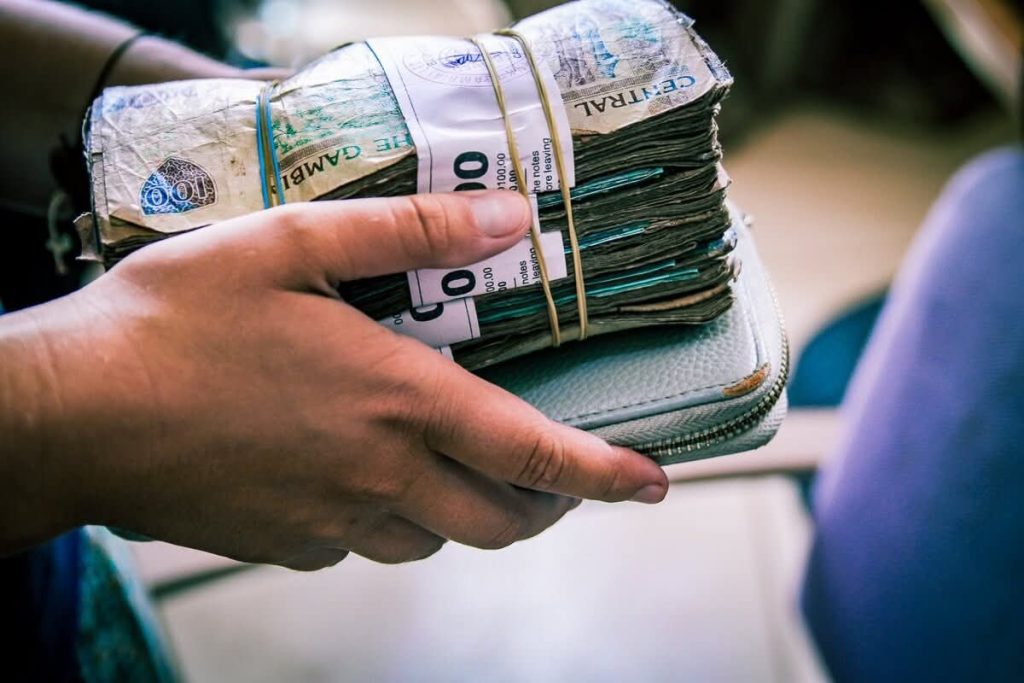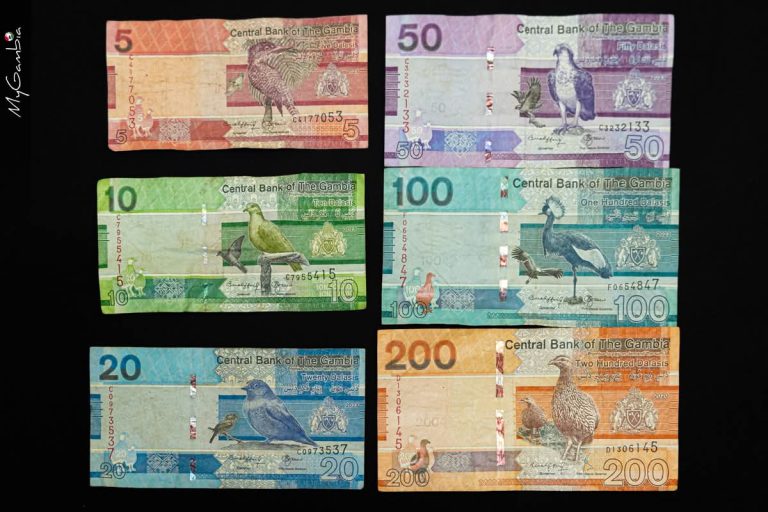
In The Gambia, the official currency is the Gambian dalasi (D). In addition to banknotes, there are also coins called bututs, although they are rarely used in everyday life anymore. Banknotes in circulation include 5, 10, 20, 50, 100, and 200 dalasi, which means that amounts quickly add up into thick stacks of paper.
Admittedly, for many volunteers and visitors, one of the more special moments in The Gambia is not the ocean or a sunset, but the moment when they exchange or withdraw money for the first time.
It is that moment when you walk up to an exchange office. Or to an ATM – if you are lucky and it works. In your hand, you hold foreign currency or a card, and in your mind there is a simple question: will it work?
And then… it does.
What you receive is not one banknote. Not even two. But a whole stack. A thick bundle of dalasi that you can barely fit into your wallet. For a second, it feels like you have become rich. But you haven’t. This is The Gambia. This is the dalasi.
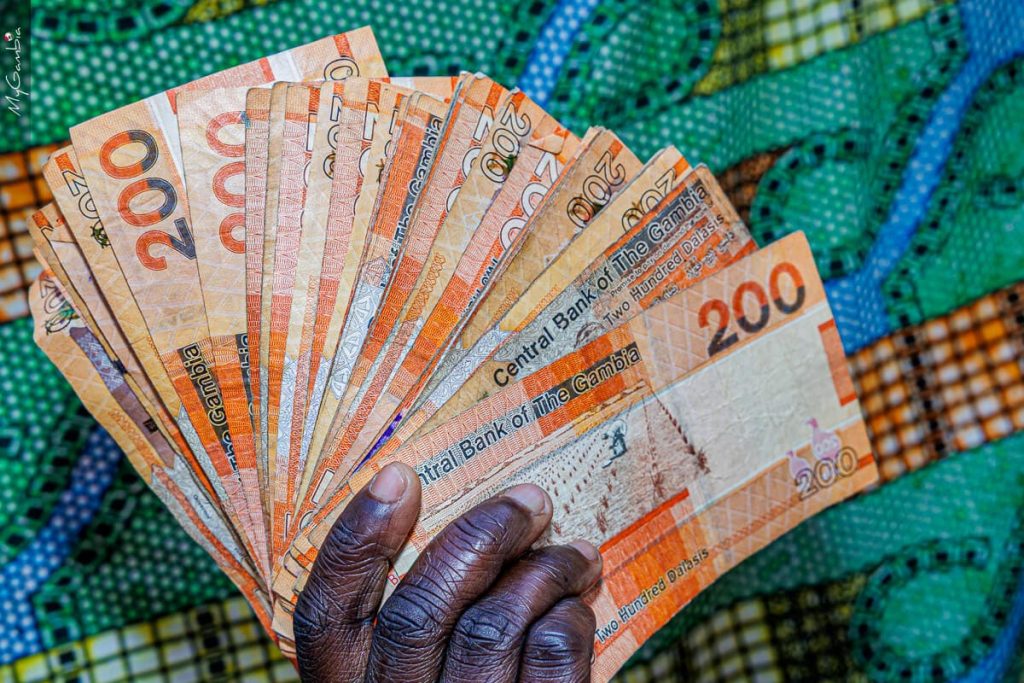
The largest banknote is worth 200 dalasi, which is why money here quickly “grows” into something that looks much bigger than it actually is. What would be a single banknote at home becomes a hand full of cash here. And that is one of the first things that surprises you – money here does not look the way we are used to.
You also quickly realize something else: cash is not a choice, but a reality. Cards work only occasionally, mostly in some hotels or tourist facilities, while elsewhere you almost always pay in cash. This means you start thinking differently – no longer “I’ll just pay”, but how much cash you have, how much you still need, and whether you have enough for the day.
Many people wonder before traveling whether they need to exchange money in advance. In reality, this is usually not necessary, as dalasi are often not available outside The Gambia. That is why money is typically exchanged only upon arrival. You have several options: banks, exchange offices, hotels, or the airport. The airport is convenient for the start, but the rates there are not the best. Banks and official exchange offices are usually the most reliable and offer better rates, so it is worth comparing. It is also advisable to exchange money gradually and compare rates as you go, as they may vary.
Then comes the reality that everyone quickly experiences: ATMs. You go to one, insert your card, wait… and then realize that nothing is guaranteed. Sometimes they work, sometimes they don’t. Sometimes they run out of cash. Sometimes the network goes down. An ATM here is not a certainty – it is more… a matter of luck.
That is why you quickly learn one important rule: always have some cash in reserve. Because here it is not only money that can run out – sometimes the system does too. Gradually, you start thinking ahead – you withdraw a bit more, exchange a bit earlier, and always keep something “just in case.”
At first, all of this surprises you. Then it confuses you a little. And in the end, it simply becomes part of everyday life. When someone hands you a stack of banknotes and you don’t react. When you walk past an ATM and don’t rely on it. When you always know how much cash you have in your pocket.
And that is when you understand – the dalasi is not just money. It is part of the experience, one that teaches you adaptability, patience, and how to live a little differently than at home – a little more the Gambian way.